HMDD Pullover Hoodie Outfit Ideas Styling Inspiration

By Josh Goodwin, MD, FAAPMR
Posted 5th October 2026

Most Effective Methods to Mix HMDD Clothing With Basics You Already Own

Until you put it to it, building a wardrobe around a one-brand label feels far-fetched — the real skill lies in learning how to mix what you already own, not owning more. HMDD, standing for Happy Memories Don’t Die, has built a reputation on items that blend streetwear and casual basics, which makes them remarkably easy to work into an current closet. It’s not the kind of brand that asks you to rebuild your whole rotation around it. Depending on the mood you’re dressing for, HMDD clothing works as either the centerpiece piece or a secondary one. In 2026, with layering and mixed-texture outfits still leading casual dressing trends, that adaptability matters more than ever. This article walks through practical pairing strategies for HMDD hoodies, sweatpants, shorts, and tees, using items most people already own, like plain denim, white tees, and neutral outerwear.

Why HMDD Pieces Blend Well With What You Already Have

Design restraint is a big part of why HMDD clothing blends so easily into a varied wardrobe. Because the prints make a statement without overwhelming, a single HMDD piece can anchor a look while everything else stays understated. Reviewers who take a in-depth look at HMDD time and again highlight how striking visual identity is matched with wearable silhouettes. That balance is why a hoodie from this happy-memories-dont-die.com/hoodies label doesn’t clash with plain black joggers or a basic denim jacket.
A down-to-earth sizing logic is likewise in effect. Since HMDD sweatpants and outerwear favor roomy and laid-back fits, they go easily with close-cut basics. Wearing a slim white tee under an roomy HMDD hoodie builds contrast without requiring a stylist’s eye. Likewise, HMDD shorts cut straight or relaxed pair nicely with fitted tanks or compression layers once warmer months arrive. The brand’s design DNA reflects an understanding that most people don’t buy head-to-toe outfits from a one brand, and that consideration shows in how adaptable the pieces are when combined with unrelated items.

How to Build an Outfit Around a Single HMDD Anchor Piece

The one-anchor method is the most basic formula to work HMDD clothing into your rotation: choose one statement piece and assemble the rest around it with clothes you have. When your anchor happens to be a printed hoodie, maintain the bottom half neutral — think grey sweatpants, black sweatpants, or straight-cut jeans in a medium-wash denim. Should your anchor be a set of HMDD sweatpants with a noticeable print or wash, counter it with a solid-toned top, ideally in white, black, or heather grey, so the sweatpants stay the centerpiece.

This method also works in reverse for hotter months. HMDD’s shorts, when used as the anchor piece, go well with a plain crewneck or a basic long-sleeve worn beneath a jacket when evenings turn cool. The idea is far from complex, but it calls for restraint: fight the temptation to bring in a second statement item. Two statement items clashing in one outfit usually reads as cluttered rather than purposeful. In coverage of HMDDLA-related styling content, fashion editors have flagged this same principle while discussing how West Coast-influenced streetwear brands carry over into everyday looks — a single standout item, the rest playing a supporting role.

Layering Approaches for Winter

Layering is where many people either get right or get wrong an outfit, and HMDD pieces provides multiple options depending on the temperature. A midweight HMDD hoodie functions well as a middle layer under a plain wool coat or denim jacket, assuming the hoodie’s fit isn’t overly bulky underneath. If you own a simple puffer vest, that’s another straightforward layering choice — the vest provides warmth without hiding any graphic detail on the front of the hoodie.

In colder climates, consider a triple-layer method: a simple long-sleeve base layer, an HMDD hoodie piece in the middle, and a structured outer layer like a bomber or trench on top. This makes the outfit practical for temperature regulation while still allowing the HMDD garment visibility. The sweatpants in this setup need to stay simple — solid black or grey sweats anchor the outfit and keep it from appearing overworked. The priority in winter styling is consistently warmth first, aesthetics second, and the relaxed fit of HMDD pieces work with that layering logic without requiring you to go up drastically in size.

Warm-Weather Pairings With Shorts and Tees

Once it heats up, the styling calculus shifts toward minimalism. HMDD shorts matched with a plain white or black tee is nearly as reliable as warm-weather outfits get, and it’s a combination that works whether you’re running errands or grabbing lunch with friends. Adding a simple cap or a set of plain sneakers you already own finishes off the look without requiring more shopping.

If you’d rather lean slightly upscale, trade the tee for a plain button-up shirt, worn open over a tank top, layering HMDD shorts beneath it. This approach really shines during warm-weather evenings where you want something a step above pure athleisure. Reviewers discussing HMDD clothing in warmer climates, particularly those referencing HMDDLA’s West Coast roots, often point out that the shorts hold their shape well through multiple wears, which is important if you’re planning to rotate them frequently during summer months.

Footwear and Accessory Choices That Keep It Balanced

Shoes are frequently the determining element in whether an outfit looks put-together or mismatched. Paired with HMDD sweatpants or shorts, classic white sneakers remain the most dependable and adaptable option, mainly since they avoid competing with any graphic elements above the waist. Black sneakers or minimalist slides work just as well for a more understated vibe, especially during warmer months when shorts are in rotation.

The same principle of restraint mentioned earlier applies to accessories. A plain baseball cap, a simple crossbody bag, or a basic watch are enough to round out an outfit without introducing competing patterns or logos. The goal is for the HMDD piece — whether it’s a hoodie, sweatpants, or shorts — remain the outfit’s focal point while everything else plays a supporting role. This is a lesson that comes up repeatedly in community discussions and HMDD review threads: piling on too many accessories usually weakens the clothing’s effect instead of boosting it.

HMDD Pieces and Basics: A Pairing Comparison

The HMDD Garment Top Basic to Pair With Time of Year Outfit Tip
HMDD Hoodie A basic white tee with mid-wash denim Fall/Winter Layer under a denim or bomber jacket
HMDD Sweatpants Solid crewneck or tank Fall/Winter Keep top half neutral to highlight the pants
HMDD Shorts Simple tee or button-up worn open Spring/Summer Finish with white sneakers for a crisp look
HMDD Graphic Tee Basic joggers or straight jeans Year-round Let it serve as the outfit’s one standout element

Frequent Errors to Steer Clear of When Combining Brands

The most frequent mistake people make when mixing HMDD clothing with basics is overcrowding the outfit with too many focal points. When the hoodie carries a large chest graphic, avoid pairing it with strongly patterned pants or brightly colored shoes. Simplicity is what makes the mixing strategy work in the first place, and abandoning that principle usually results in an outfit that comes across as cluttered instead of intentional.

Silhouette balance are often overlooked, and that’s a further common pitfall. Because a lot of HMDD clothing leans toward relaxed or oversized fits, matching an oversize hoodie with equally roomy sweatpants can at times swallow your frame. Counterbalancing a roomy top with a comparatively tailored bottom, or the reverse, maintains the silhouette intentional. Finally, be sure not to miss fabric weight mismatches — pairing a hefty HMDD hoodie with flimsy, light basics can look off-kilter, most notably in photos or under harsh lighting. Coordinating fabric weights roughly, notably top to bottom, maintains the overall outfit cohesive.

Concluding Thoughts on Creating a Flexible Rotation

Working HMDD garments with items you already have has nothing to do with overthought systems; what matters is grasping balance, holding back, and letting one standout piece anchor each look. Whether you’re working with a hooded pullover, sweatpants, or shorts, the brand’s easy, laid-back cuts and balanced graphics make it simpler than the majority of streetwear labels to fold into an existing wardrobe. What actually matters, as more shoppers explore what makes the best HMDD clothing pieces worth owning in 2026, seems to lie not in acquiring more items, but in discovering how a handful of well-chosen items can multiply your styling possibilities through easy, considered mixing.


Ferragamo Premium Flap Bag Ferragamo Sale

By Josh Goodwin, MD, FAAPMR
Posted 5th October 2026

Ferragamo Bags: The Full Guide to the Collection

A Ferragamo bag comes to mind at once yet resists a tidy summary. On the brand’s own United States webstore in September 2026 there were 279 handbags listed, starting from roughly ninety top handles and down through minis, clutches, crossbodies and totes. This guide follows how the collection holds together rather than how a catalogue lays it out: one headline silhouette, architectural families ranged around it, an accessible hardware line underneath, a thin exotic tail. The numbers below are observed 2026 market prices, logged on a single day rather than an official price list. A Florentine house headquartered at Palazzo Spini Feroni, it trades on Borsa Italiana as SFER, and Maximilian Davis has been creative director since March 2022. Treat what follows as a map, not an inventory.

Where the bags began

Leather goods are the younger half of this house, and keeping it in mind changes how you read them. The business was built on footwear by Salvatore Ferragamo from 1927; bags appeared in 1965, when Fiamma Ferragamo set about designing handbags and small leather goods as accessories to the shoes, and the first press article showing a Ferragamo bag is dated 1969. Everything since then is bag history. Conceived beside a wardrobe that already had a point of view, they are organised around a closure rather than a logo. Structure was part of the package: panels shaped and held, edges finished with care, and most silhouettes holding their shape when empty. From 1967 design and prototyping were based out of the Osmannoro facility near Florence, and “Made in Italy” still appears on every current bag page.

The Hug, and why it sets the tone

Right now the collection is led by one design: the house’s own craftsmanship pages call the Hug its modern accessory icon. It is a architectural, asymmetrical top handle: the side panels fold inwards and are held by wrap straps fastened with two golden Gancio buckles, so the closure works as the ornament. It comes in XS, M and L, in calfskin, suede and raffia, generally including a detachable strap and a keychain charm on the zip ring. A sub-family has grown around that core: ferragamo tote a slouchy Hug Soft shoulder bag, a bicolour Hug Soft, an elongated Hug East-West and a Hug mini crossbody. On observed prices the XS comes in at $2,500 to $2,650, the medium at $3,400 to $5,700 and the large at $3,600 to $3,900. Such a range is the reason the Hug touches almost every corner of the assortment.

Cara, Studio and the hard-edged shapes

The hard-edged side of the collection belongs to the Cara and the Studio families. Newest of all is the Ferragamo Cara, a slim architectural shoulder bag in XS and S closed with a Gancini, pushed as the Fall/Winter 2026 story and placed first in the site’s hero navigation. Observed at $3,400 for the XS and $3,700 for the S, it asks to be judged on line rather than capacity. The Studio Bag is the house’s permanent architectural collection, and it splits in two. The Studio Box is a structured top handle with a Gancini clasp in soft calfskin at $2,550 to $3,100; the Studio Soft is rounder and more voluminous in hammered leather, canvas or raffia effect, at $3,200 to $3,600. Next to them sits the Iconic Top Handle, a small accordion-sided shape the house calls a re-release of one of its best-known styles, in leather or hand-woven wicker with silk lining.

Soft shapes, totes and evening

The soft side, not the architectural one, is where most daily wear in this collection sits. The Ferragamo Soft-bag is what its name suggests, an unstructured shoulder bag observed at $2,100 to $3,500 in small and $2,950 in medium. The Sofia 2026 shoulder bag is the newest soft entry at $2,700 in medium and $3,200 in large, and the official spelling is Sofia even though one retailer files it as “Sophia”. Totes cover the practical end: the Mia in large at $2,400 to $5,700 and the folded tote at $1,850 to $2,100. Evening is handled by the Diana clutch at $2,200 to $4,500 and a mini clutch family from $1,650. A hobo appears at both ends of the ladder, the XS at $1,090 and the medium at $4,300.

Gancini: the heritage line and the way in

The hook motif is the heritage anchor and, in practice, the least expensive way into the house. Its first appearance is documented rather than guessed: in 1972 Women’s Wear Daily published a photograph of a Ferragamo bag with a hook-shaped metal closure. Today it works as a functional clasp, as cast hardware and as an embossed or outlined pattern across leather and jacquard. Most first purchases happen in the Double Gancini group: a top handle XS at $2,500, crossbodies from $2,400 to $2,900 with one observed as low as $830, and a clutch at $880. A Gancini chain mini at $1,850 and an outline tote at $1,750 to $1,850 sit just over that. The family tops out with a medium Gancini handbag in python with golden hardware and suede lining, observed at $4,100.

What the collection costs

Read as a whole, the price architecture is calmer than the headline numbers suggest. For a current bag the working range runs roughly $830 to $4,800, and above that sits an exotic tail most shoppers never encounter. Depending on the variant, the recognisable Hug begins between $2,100 and $2,500, so the most identifiable design falls well below the ceiling. Gancini hardware holds the floor, Studio and Soft occupy the middle, and the Cara and larger Hugs define the upper band. Because the same silhouette in python can multiply its price several times, material shifts a bag between bands as readily as size does. The table arranges those observed 2026 market prices; they were noted on one day and are not an official price list.

Tier Models in this band 2026 market range, as observed
Entry level Double Gancini crossbody and clutch, wallet with chain, hobo XS, multi-pocket bucket $830 to $1,500
Main body Tote, mini, Gancini outline tote, folded tote, Soft-bag, Hug East-West, Hug mini and XS $1,650 to $3,500
Upper band Cara, Hug L, Hug Soft L, Gancini python, Iconic Top Handle, Mia tote L $3,400 to $5,700
Exotic tail exotic-leather Hug XS, Iconic Top Handle S, Diana clutch, Studio Box S $7,500 to $24,000

Materials, metal and making

The composition fields on the brand’s product pages are plain-spoken and tell you most of what matters. Calfskin appears in two personalities, smooth and grained or hammered, and the grained version hides a season of real use far better. Suede threads through the Hug family and photographs beautifully, but it is the most weather-sensitive surface in the range. At the top of the ladder, and scarce, is python. Character in the warm-weather assortment comes from the woven materials, hand-woven wicker with silk lining, raffia, canvas and jacquard. The hardware is for the most part gold-tone Gancio; every current page carries “Made In ITALY”; and no public care guide is published by the label, whose only official aftercare is Repair Services requested at selected boutiques.

Where to buy: shops, sales and the outlet question

Ferragamo trades through its own regional webstores and around 354 stores in the official locator, and it supplies verified stockists including Nordstrom, Bloomingdale’s, Saks Fifth Avenue, Mytheresa and Farfetch. Rather than undercutting, authorised retailers respect recommended prices: one has a small Hug East-West at $2,500 and a medium raffia Hug at $3,400, identical to the label’s own figures. A Ferragamo sale is genuine, taking the form of seasonal sale sections on the brand’s own site; in the between-seasons window of early September 2026, however, no sale link surfaced in live navigation. The Ferragamo outlet question calls for precision: the house operates stores inside outlet villages, from The Mall Firenze near Florence to a dozen or more Simon Premium Outlets locations, yet its own locator labels none of them “Outlet”, and there is no official online outlet at all. That is the most useful thing to carry into a browser, since any site presenting itself as an official online outlet is not the brand. For 2022 alone the house reports taking down 107 fraudulent websites and 89,136 counterfeit listings, and its stated instruction is to buy from its website, a Ferragamo shop or an authorised distributor.

Picking one

How you carry, not the name on the label, is the place to begin. If you want the design most identified with the house today, the Hug in XS is the shortest route, and its verified measurements are honest: height 5.5 inches, length 8.8 inches, width 4.3 inches, a strap of 21.7 inches and a handle drop of 2.9 inches. If you need capacity, the Mia or folded totes make more sense than a larger Hug. If you want the heritage without the outlay, a Double Gancini piece delivers the motif at the bottom of the ladder. If you want something unlike the rest of the range, the Cara is the current statement. One practical note for pre-owned hunting: resale platforms still file all of this under Salvatore Ferragamo, so search both names.

Spider Outfits Official Portal Destination Info Authentic Sp5der

By Josh Goodwin, MD, FAAPMR
Posted 5th October 2026

What counts as a “SP5DER piece” in 2025?

In 2025, “Spider hoodie” most commonly refers to streetwear hoodies featuring spider web graphics and the SP5DER branding associated with Young Thug’s label, not the unrelated ski brand Spyder. If you’re buying, treat “SP5DER,” “Spider Worldwide,” and web-graphic hoodies from the brand’s seasonal drops as the main grouping, and eliminate unrelated athletic or novelty prints.

The streetwear variants are distinguished by roomy profiles, heavy material, bold web motifs, and either puff-print or thick ink applications. Colorways rotate by drop, with repeated black, vintage gray, red, and vivid neon shades, plus seasonal pastels. Zip and pullover variants appear in each year’s releases, and print positioning is part of the brand language: prominent chest designs, back placements, and sometimes arm or hood details. Because “spider” is a generic word, listings often blur the brand name; you need to verify tags, print standard, and construction to validate you’re looking at the correct product.

How do real and fake SP5DER pieces differ at a quick look?

Authentic pieces feel dense in hand, show crisp prints with controlled texture, and carry consistent branding in labels and care tags; fakes usually to be less substantial, with glossy or rubbery prints and careless typography. Pricing, mass, and label correctness combined indicate authenticity.

A quick triage before deep validation works like this: examine silhouette and hang from a direct photo, then examine neck and cleaning labels for correct brand marks and layout, then review print boundaries and texture under good light. If any of those three fail—fit looks cheap, tags read oddly, or the print halos/bleeds—assume replica until proven otherwise. For online posts, ask for specific flat measurements, natural-light photos, and a actual weight; the blend is hard for fakes to fake convincingly.

Authenticating details: tags, prints, build

Genuine SP5DER pieces merge uniform brand components with solid fabrics and construction, while fakes skimp sp5der set on labels, inks, and stitching. Check labels first, then prints, then construction.

Real neck markings align and stitch cleanly, and the brand lettering is consistent within a release, including the custom numeral 5. Care labels use clear material breakdown and care directions with clean letter spacing and no strange capitalization, and string terminations are heat-sealed or neatly finished. Prints on genuine pieces show deliberate texture: textured print zones rise consistently, edges remain defined, and there’s little haloing; standard inks are dull to moderately shiny, not plastic-like. Build quality appears in dense stretch sections at cuffs and lower border, tight side stitching, and smooth, even string eyelets; zips, where used, track smoothly and sit straight on body.

Are the neck tags consistent across collections?

Neck labels are consistent within a individual drop, and authentic runs don’t mix fonts, spacing, or brand names. If a individual hoodie shows one type of brand treatment on the collar label and a separate one on the cleaning instructions, something is off.

Look for a single dominant brand identity inside the garment, not a mash-up of styles. Fonts shouldn’t differ between the neck tag and the care label where the company title is repeated. Construction around the label should be uniform with no dangling loops, and the label should sit flat without puckering. Hang tags, when present, correspond to the branding tone and avoid misspellings or odd QR codes that lead to nothing.

Does the print look and feel correct?

Authentic web graphics read sharp at the edges and align symmetrically on the garment; poor registration or fuzzy boundaries are red flags. Puff-print sections should feel raised uniformly, not patchy.

Under angled lighting, genuine prints exhibit controlled texture without glossy glare, and colors rest evenly on the material without seepage into the knit. On worn items, light fracturing on puff areas can happen, but the ink mustn’t flake in sheets. On zip hoodies, artwork should split cleanly at the zipper teeth without misalignment from left to right. If the print smells strongly like harsh compounds or feels rubbery and sticky, be careful.

How should stitching and hardware seem?

Stitched lines should run direct with balanced pull, and rib borders should feel thick with good elasticity. Button openings or eyelets for cords are supported and clean.

Authentic zip models use smooth, straight-set zippers that slide easily; the tape is straight and the end piece is even. Thread color typically matches the base material or design purpose, not random difference that looks accidental. Inside, serged stitching should be tidy with consistent formations—no loose fibers hanging at stress points. Weighty drawcords and neat tip finishes finish the picture.

How should SP5DER pieces fit in 2025?

Plan for a boxy, slightly roomy fit with wide chest width and moderate body length. Most buyers wear TTS for the desired drape, and reduce size one if they prefer a closer fit.

The silhouette targets for dropped shoulders and a generous torso that fits over tees without feeling sloppy. The hem usually sits at or slightly below the hip, and arm sections are full but not wildly long when sized TTS. For casual athletic layering under coats, size down one can reduce bulk at the midsection and wrists. For longer frames, the boxy fit’s shorter body length can be a factor—check garment dimension carefully to avoid a cropped look. Women transitioning from men’s sizing often go down one from their typical unisex size for a even profile.

What size should you pick if you’re in between sizes?

If you sit between sizes, select based on your preference: drape or neatness. For the label’s intended look, stay with the bigger of the two; for a neater fit under coats, pick the tighter.

Layering matters: if you’ll layer a heavyweight tee or flannel under the piece, the larger size preserves arm mobility. If you typically wash warm and tumble dry, the smaller size may shrink more than you expect over time, so plan care accordingly. Check seller-provided flat measurements against a piece you already possess and like. Aim for chest width within 1–2 cm of your preferred piece for a similar feel.

Measurement checklist you can request from sellers

Request for four specs taken flat: chest width from pit to pit, back length from upper shoulder to hem, shoulder width point to point, and sleeve length from shoulder point to cuff. These four measurements let you predict fit accurately.

Ask for photos of the measurement tool on the garment to confirm accuracy. A quick measured weight in grams gives a bonus signal on fabric weight. If buying a zip hoodie, also ask for the measurement across the waist ribbing, which influences how boxy the piece looks when worn. Keep these numbers in your files to compare across offerings and seasons.

Where can you securely buy Spider Hoodies in 2025?

The safest path is direct from brand releases and verified boutiques announced by the company, followed by reputable resale platforms that offer authentication and consumer safeguards. Random social posts and heavily discounted shops pose the greatest risk.

Begin by following the brand’s official site and social accounts for drop calendars and any stockist announcements. If you skip a drop, turn to proven marketplaces with clear guidelines on apparel authentication and returns. When dealing with person-to-person sellers, prioritize escrow or platform transaction security and avoid external deals. Keep images of listings and conversations; documentation helps if a dispute arises. Cross-check photos with collector samples and past sales to avoid suspicious fakes.

Primary channels to track

Track the company’s official website and email updates for drop periods, and watch its official social media for inventory alerts. In-person pop-ups announced by the company are also dependable.

Some collections show up in capsules or collaborations; those are generally flagged beforehand on official channels. Prepare for limited windows and waiting systems, so having an registration and payment ready reduces friction. Pricing at these sources sets the standard you’ll use to assess aftermarket listings. If a vendor is named in official communications, you can treat it as a reliable source for that specific release window.

Secondary marketplaces: danger control

Use platforms recognized for apparel authentication and buyer protection, and read category-specific policies because security can vary by area. Review seller reviews, transaction quantity, and photo authenticity before bidding.

Request for time-marked photos, tag close-ups, and measurement shots; avoid sellers rejecting reasonable verification. Pay with systems that preserve dispute rights. Be suspicious of listings with brand name obfuscation, mismatched stock photos, or prices far below market; these groups correlate with fakes. Match SKU details, color names, and artwork location with confirmed real pairs in sold records.

Pricing benchmarks and launch schedules

Retail pricing sits in premium streetwear territory, and aftermarket prices vary by colorway, season, and condition. Very low prices compared to current market standards are a risk signal.

Core colorways and simple graphics tend to maintain value better, while bold seasonal colors can swing wider after initial hype. Zip versions often require a small premium over pullovers when the print placement is desirable. New-year releases see short surges, then stabilize as restocks or alternative color options land; patient customers can sometimes catch bargains in the lull. Track completed listings, not posted prices, to understand current value before negotiating.

Care, wear, and lifespan: keeping prints undamaged

Cold wash flipped, reduced agitation, and air-dry to preserve both material feel and print texture. Heat is the threat of puff and heavy inks.

Use a mild soap with no harsh chemicals, avoid fabric softener that can smooth fibers, and wash with matching weights to reduce wear. If you need to machine-dry, use the lowest heat setting and extract while slightly damp. For keeping, hang briefly to reform, then fold; long-term hanging can stretch shoulders on heavyweight fleece. Spot-clean oils promptly to prevent staining on lighter colorways.

Quick comparison table: real vs replica signals

Use this side-by-side to evaluate a listing rapidly before deep dives. If two or more categories skew fake, wait and request more proof.

Check Genuine Signal Common Replica Tell
Brand markings/Tags Consistent SP5DER typography and clean spacing across neck and maintenance markings Inconsistent fonts, typos, or varying brand treatments on various tags
Print Quality Sharp edges, even puff rise, non-shiny to semi-matte finish Blurring, bleed, shiny plastic sheen, patchy puff height
Material/Mass Substantial handfeel; ribbing with strong recovery; substantial measured weight Light, floppy fleece; thin ribs; sellers avoid sharing weight
Construction Even seams, tidy overlock, aligned zips, clean holes Wavy seams, loose threads, offset zipper graphics
Pricing Close to current retail or market mean for the colorway Deep discounts far beneath fair market without explanation

Did you know? Established facts about SP5DER pieces

These points help you handle naming confusion and community practices around listings and checks.

First, SP5DER represents a streetwear brand linked to Young Thug; it is distinct from Spyder, the ski gear manufacturer. Second, many listings dodge exact brand names in headers to dodge system moderation, so spelling modifications aren’t proof of legitimacy; treat them as signals to dig deeper. Third, genuine pieces show up across multiple seasons and can have differences between drops; validate within-season, not by matching to a unrelated year. Fourth, community sellers often provide flat measurements and actual weights on request—serious resellers expect these asks and reply quickly.

Expert Tip: “Request the seller for a short recording in natural light that displays the neck marking, the wash tag, and a slow finger pressure across the print. Uniform branding, clean care-label typography, and a print that bends and rebounds evenly will tell you more in ten seconds than ten studio photos.”

Ready to buy? Run this final assessment guide

Confirm branding consistency across all labels, verify print texture and edge clarity in natural light, and match flat measurements to a hoodie you already own. If a single one of these pillars fails, step back.

Check the asking price with recent finalized data for the same colorway and style. Ask for a scale weight if the fabric seems thin in photos. For zip garments, check artwork alignment across the teeth and zipper tape alignment. Pay only on marketplaces that protect the purchaser and keep your records until you’re satisfied with the piece after receipt.

Essay Writing – The Value of a Good Thesis Statement

By Josh Goodwin, MD, FAAPMR
Posted 5th October 2026

1

Valentino Studded Bags Rosso Valentino Red

By Josh Goodwin, MD, FAAPMR
Posted 4th October 2026

Valentino Tote Bags: Rockstud Mini Shopping to Panthea

A tote is the least romantic bag a luxury house makes and usually the most used. It needs to carry a laptop, survive a commute, and still look like it cost what it cost. Rather than a sprawling category, Valentino Garavani offers a small, clearly graded set of shopping bags, and that makes choosing easier than it looks. What follows climbs the ladder from the most accessible piece upward, sets out what separates the rungs, and flags the tote names that fill search results but can no longer be bought new. All the numbers here were observed in the market during 2026 research; none comes from an official price list. Take them as orientation rather than as a quotation.

Which bags count as totes here

The word the house uses is “shopping” rather than tote, and knowing that makes the category easy to navigate. Unlike the crossbody idea, which has no category page of its own, Totes is a real destination in the brand’s navigation, alongside Shoulder Bags, Top Handle Bags, Clutches, Wallets and Small Leather Goods. What sits there is narrower than the shoulder shelf. Three current pieces make up the category: the Rockstud Mini Shopping bag, the VLogo Signature Shopping bags and the Jean medium shopping bag. Two names that dominate tote searches are no longer part of it, as set out below. Every piece in the current group is made in Italy, which the brand states on its product pages.

Rockstud Mini Shopping: where the ladder starts

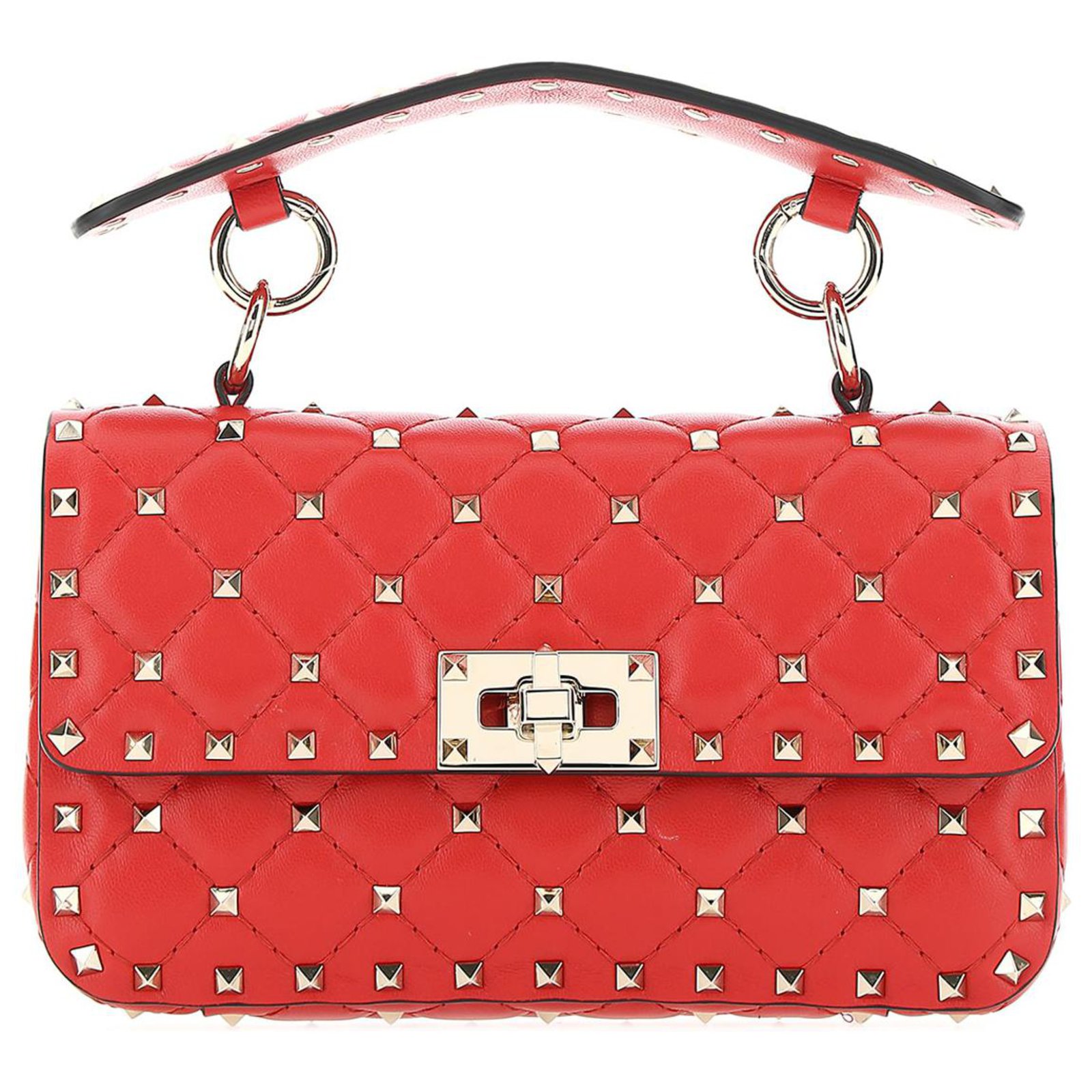
If you want a valentino tote bag without stepping deep into four figures, this is the piece. Prices observed in 2026 start at $1,390 for grainy calfskin designer bags or suede, reach $1,490 in raffia, and continue to $1,750 in laminated calfskin and $1,850 in pony-effect calfskin. Across that spread the model and the size hold steady, and only the surface moves. That single fact explains most Valentino pricing and is the most useful thing to know before comparing listings. The bag carries the pyramid studs introduced in Fall 2010 by then co-creative directors Maria Grazia Chiuri and Pierpaolo Piccioli, first seen on footwear and drawn from the rusticated stonework of Roman architecture. As the only tote in the entry band, it is the piece most first-time buyers of valentino bags end up handling.

VLogo Signature Shopping: the mid-ladder answer

Move up and the VLogo Signature shopping bags take over, observed in 2026 at $2,650 to $3,750 in suede or soft leather. VLogo Signature is the house’s contemporary “V” emblem used as hardware and closure, and it runs across clutches, bucket, bowling and shopping bags, so the tote belongs to a coherent family. The cheapest pieces in the range sit in that family too, with grainy calfskin clutches at $650 to $790 and a moire clutch at $750, so the emblem by itself signals nothing about price. In tote form the jump over Rockstud Mini Shopping is roughly a thousand dollars, bought with size and softer materials. Anyone wanting a bag that reads as Valentino without studs ends up here. A mini bucket in nappa at $1,450 sits alongside it if the shopping shape is more than you need.

Jean medium shopping bag: the top of the current group

Observed in 2026, the most expensive current shopping bag is the Jean medium, in nappa chevron at $3,650. Chevron construction recurs across the house’s leather goods, and here it puts a directional surface on a straightforward tote silhouette. At that price it sits at the top of the mid band, just under the $3,700 threshold where the top band begins. It is worth comparing with the upper VLogo Signature shopping bags at $3,750, because the two coincide almost exactly on price while looking nothing alike. That overlap reveals how the house builds a range, with parallel families at similar prices rather than one escalating ladder. The choice between them is about surface preference rather than quality tier.

The tote ladder at prices observed in 2026

The table lines up the shopping bags, naming the material each price was recorded in and adding a note on availability. Two rows appear because they are not buyable new, since both names still dominate search results. Take the current rows as a 2026 market snapshot rather than an official tariff. The full spread is $1,390 to $3,750, wide but not extreme for one category. Inside that spread, material and size do all the work, and no current tote climbs far into the top band above $3,700. That is a deliberate position: totes here are working bags, and the house puts its spectacle elsewhere.

The piece Material seen 2026 observed price (USD) Availability status
Rockstud Mini Shopping Grainy calfskin, or suede $1,390 Currently offered
Rockstud Mini Shopping Raffia $1,490 Current
Rockstud Mini Shopping In laminated calfskin $1,750 Currently offered
Rockstud Mini Shopping Pony-effect calfskin version $1,850 Current
VLogo Signature Shopping Suede, or soft leather $2,650-3,750 Current
Jean Medium Shopping Nappa chevron $3,650 Currently offered
One Stud large tote Nappa $1,695 at a third-party retailer Archive, not sold officially
VLogo Escape tote Quilted or hammered leather Not sold new Discontinued, secondary market only

The tote names you can no longer buy new

Two famous totes are worth getting straight before the hunt begins. The One Stud tote, built around a single oversized stud, is not in the brand’s current filters, and a large nappa version observed at $1,695 was listed by a third-party retailer rather than offered officially, so treat it as archive. Reported as discontinued by a resale platform, the VLogo Escape tote was made in hammered or quilted leather with double handles, a removable strap and gold-tone hardware, and now exists on the secondary market only. Other familiar names are in the same position, since Roman Stud, Supervee and Stud Sign are absent from the current filters, and a small Roman Stud handle bag observed at $3,550 was flagged as reserved rather than orderable. None of that makes those bags inferior, only that buying one means buying pre-owned. What changes is what you check, where you buy and usually the price.

How Panthea fits, and why it is not a tote

Panthea comes at the top of every Valentino price conversation, and it appears in a tote guide mainly to mark the ceiling. Starting at $3,800 for chevron nappa or suede, observed 2026 prices go to $5,650 in python, $7,600 in ostrich and $7,900 embroidered, leaving it the most expensive current family. It sits under shoulder bags rather than shopping bags, which is the point, since the house does not build its most expensive pieces as totes. If your budget reaches Panthea money and you still want to carry a laptop, buy two bags rather than one. Exotic skins also bring obligations, since python and ostrich need professional care and are unforgiving of daily use. A tote pays for itself in hours carried, a different kind of value altogether.

Choosing one, and caring for it

The practical decision comes down to surface, because every current shopping bag is competent as a container. Grainy calfskin is the most forgiving option and the easiest to live with. Suede and raffia are the better-looking and the more demanding, both wanting distance from water and oils, and suede should be brushed dry and protected by spray. Laminated, metallic and pony-effect finishes are the most demanding, as the failure point is the coating rather than the leather beneath, and abrasion against desks and car seats is what ages them. General luxury-leather practice, not brand instruction, is to wipe nappa and calfskin with a soft dry cloth, use a nappa cream, blot stains rather than rub, and let a damp bag air dry away from heat. Store it in its dust bag, lightly stuffed, cool and dark, and leave the hardware alone, since antique-brass and light-gold plating wears through if polished.

A short note on the house behind the bags

A little context helps when you are spending this much. Valentino Garavani started the house in Rome in 1960 with Giancarlo Giammetti, and the creative headquarters are still there. He sold the company in 1998, retired from design in 2007 with a final couture show in January 2008, and died on 19 January 2026 aged 93, which means he had no hand in any bag sold today. The business is owned by Mayhoola for Investments, which took 70 percent in 2012, alongside Kering, which acquired 30 percent in July 2023 with a stated intention to take full ownership by 2028. Per the most recent confirmable reporting, Alessandro Michele has been creative director since 2024, succeeding Pierpaolo Piccioli. One last thing: this house is entirely separate from Mario Valentino of Naples, and only its bags carry VALENTINO GARAVANI on the interior tag.

Skate Culture Pants SS26 Arrivals

By Josh Goodwin, MD, FAAPMR
Posted 4th October 2026

Why Palm Angels Streetwear Dominates the Fashion Landscape

There is a vibe about Palm Angels that just resonates distinct. Walk into any luxury streetwear shop in 2026, swipe through any carefully selected Instagram feed, or notice what the most stylish people at any music gathering are wearing, and you will notice the name at every turn. But this is not the kind of presence that dilutes a label — it is the kind that cements fashion clout. Palm Angels has managed to achieve what only a handful of labels in fashion history have accomplished: it became universal without ever appearing basic. Since Francesco Ragazzi launched the brand from a photography book about LA skate culture in 2015, it has grown into a giant that reportedly records north of $300 million in annual sales. And in all candor, when you consider the full scope, it makes total sense. The house does not just market clothes; it delivers a sensation, an persona, and a very defined interpretation of cool that strikes a chord across borders, age groups, and scenes.

The Founding Story That Actually Matters

Most fashion brands fabricate their narrative. Palm Angels did not have to. Francesco Ragazzi was the art director at Moncler when he got captivated with the skateboarding community in Venice Beach, California. He spent years documenting skaters, chronicling the gritty spirit, the bruised knees, the sun-bleached concrete, and the unapologetic grace of a subculture that moved totally on its own standards. That initiative transformed into a book, published by Rizzoli in 2014, and the book gave birth to a name. This founding story holds weight because it is true — Ragazzi did not engage with skate https://palmangelstee.com/ culture as an outsider hoping to co-opt visual appeal. He rooted himself in the subculture, established relationships, and established trust before ever placing a design into manufacturing. That realness is embedded in the label’s DNA, and consumers can feel it. In an era where Gen Z consumers are remarkably adept at identifying fakeness, this legitimate base gives Palm Angels a market upper hand that cannot be replicated by merely hiring the right artistic director or brokering the right collaboration.

The house’s Italian roots bring another critical dimension. While Palm Angels takes its aesthetic vocabulary from American skate culture, every creation is crafted in Milan and manufactured using the same manufacturing facilities that supplies heritage Italian luxury houses. This two-pronged personality — California cool meets Milanese craft — is the special element. It permits the brand to command $350 for a printed tee and have customers believe like they are obtaining genuine value, because the fabric quality, the seam precision, and the drape are truly more impressive to what most streetwear peers present at matching or even higher price points. Palm Angels resides in a sweet spot that precious few labels have successfully filled, and it protects that position with relentless artistic output.

Cultural Capital: The True Currency

A-List Co-Signs and Authentic Embrace

You cannot buy the kind of celebrity endorsement that Palm Angels gets. Sure, the label works with style advisors and ships pieces to notable figures, but the sheer scope of its A-list adoption points to something authentic is taking place. In the past 18 months alone, Palm Angels has been rocked by Drake, Zendaya, Lewis Hamilton, Bad Bunny, Jenna Ortega, and Mbappé, spanning music, film, motorsport, and football. This multi-genre penetration is incredibly rare. Most streetwear labels huddle predominantly in hip-hop culture, and while Palm Angels certainly has firm roots there, its appeal reaches way outside any individual community. When a Formula 1 driver rocks the same brand as a reggaeton superstar and a Gen Z actress, you understand the label has attained something that exceeds typical fashion marketing. The house allegedly devotes less than 15% of its budget to sponsored marketing, counting instead on earned visibility and lifestyle placements to boost attention — a playbook that generates a substantially higher dividend on investment than conventional advertising.

Social media accelerates this cycle enormously. Palm Angels maintains an Instagram following of over 6 million, but more importantly, the hashtag #PalmAngels produces tens of millions of impressions per month across Instagram and TikTok. User-generated content — real people rocking their Palm Angels pieces and publishing ensembles — creates a self-sustaining awareness engine that costs the house absolutely nothing. According to data from Launchmetrics, Palm Angels featured among the top 15 most-discussed fashion houses on social media during Milan Fashion Week in February 2026, beating several traditional houses with budgets many times its size. This authentic buzz is both a result and a source of the brand’s leadership: people rave about it because it is cool, and it continues to be cool because people keep gushing about it.

Why the Price Point Resonates

Palm Angels holds what fashion industry professionals call the “attainable luxury” tier. It is more costly than mall-brand streetwear but substantially less expensive than the most elite tier of luxury fashion. A Palm Angels hoodie usually retails between $500 and $750, while a comparable piece from Balenciaga or Louis Vuitton might cost $1,200 to $1,800. This positioning is remarkably savvy. It enables style-driven consumers — early-career professionals, college students with some extra income, and design-savvy shoppers — to secure a piece of genuine luxury streetwear without taking on economic hardship. The typical Palm Angels customer is between 18 and 34 years old, with a median household income assessed around $75,000, according to private retail data shared at a fashion sector summit in late 2025. This audience is considerable, increasing, and passionately involved with fashion as a mode of creative expression. By setting its staple pieces within range of this audience while including elevated items like leather jackets and tailored outerwear at premium price points, Palm Angels develops a progression of involvement that keeps customers committed as their financial power rises over time.

Brand Standard Hoodie Price Standard T-Shirt Price Target Age Group International Stores
Palm Angels $550 – $750 $295 – $395 18 – 34 12
Off-White $600 – $850 $320 – $450 18 – 35 16
Amiri $700 – $1,100 $350 – $550 22 – 38 8
Fear of God $650 – $950 $295 – $495 20 – 36 3
Balenciaga $1,100 – $1,800 $550 – $850 22 – 40 100+

Artistic Philosophy That Is Unwilling to Stand Still

Advancing Without Losing Essence

One of the most challenging things for any fashion label to do is change without turning off its foundational audience. Palm Angels has tackled this task with outstanding finesse. The brand’s early collections focused extensively on overt skate elements — loose silhouettes, large logo placement, and a color scheme dominated by black, white, and purple. By 2026, the artistic vocabulary has diversified considerably. Contemporary collections integrate tailored elements, high-tech fabrics, more muted color palettes, and artistic collaborations that move the label into terrain that would have seemed inconceivable five years ago. Yet nothing appears inauthentic. The palm tree logo still is present, the track pants are still a fan favorite, and the house’s vibe remains distinctly steeped in counterculture. Ragazzi achieves this balance by regarding Palm Angels not as a static aesthetic but as a living, progressing exchange between luxury and street. Each season adds a new dimension to that exchange without muting the ones that came before.

The house’s collaboration model bolsters this adaptive direction. Palm Angels has collaborated with brands as different as Moncler (for an sustained outerwear collection), Clarks (for a reinvented Wallabee boot), and even the NBA (for a sanctioned sportswear capsule). Each collaboration introduces Palm Angels to a new audience while delivering existing fans something novel to discover. The Moncler x Palm Angels line, in particular, has grown into one of the most market-wise profitable ongoing collaborations in luxury fashion, producing an approximate $50 million in yearly revenue. These partnerships are not random — they are deliberately vetted to align with the brand’s lifestyle vision and grow its influence without weakening its character.

The Resale Market Communicates the Reality

If you desire an genuine barometer of a house’s fashion significance, study the resale world. Palm Angels continually places among the top 20 most-traded names on platforms like StockX, Grailed, and Vestiaire Collective. Standard resale values for limited-edition pieces generally sit at 140% to 200% of retail price, demonstrating intense appetite that exceeds supply. The house’s track pants, in particular, have become a aftermarket market constant, with certain colorways achieving premiums of 80% or more over standard retail. This resale showing is notable because it shows that Palm Angels pieces preserve and often appreciate in value — a feature traditionally associated with ultra-luxury names rather than streetwear brands. For consumers, this establishes a compelling purchase case: buying Palm Angels is not just a fashion investment, it is a partial investment. For the label, robust resale performance operates as zero-cost marketing and cultural proof, bolstering the notion of scarcity and appeal.

The numbers support a bigger movement. According to a 2026 report from The Business of Fashion, the luxury streetwear sector is predicted to advance at a cumulative annual rate of 8.5% through 2030, outperforming both conventional luxury and mass-market fashion. Palm Angels is ideally placed to seize a larger-than-expected share of this growth. The house has the artistic standing to captivate style leaders, the logistical backbone to scale distribution, and the cultural relevance to sustain influence across changing consumer preferences. In an world where most labels are either culturally relevant or financially sound, Palm Angels has proven that it can be both — and that is the very reason why it leads the fashion scene in 2026 and shows no signs of losing that throne anytime soon.

Righteous Apparel Explained A Closer Look

By Josh Goodwin, MD, FAAPMR
Posted 3rd October 2026

Your Thorough Playbook to Taking Care of Your Righteous Clothing

Buying a garment is only half the story. What follows the purchase, wash after wash, year after year, dictates whether that purchase becomes a go-to piece or a regret shoved to the back of a drawer. This walkthrough lays out straightforward, sensible upkeep tips for anyone who owns or is considering pieces from We Are Righteous, a label known for heavyweight cotton, thoughtful build quality, and streetwear silhouettes built to outlast a single season’s hype. If a righteous review or two crossed your path pre-purchase, you’ll have noticed the fabric quality is frequently highlighted. Here, we continue where those reviews stop, zeroing in on upkeep: how to clean, dry, keep, and mend your pieces so they keep looking the way they did on day one.

Why Care Instructions Matter More Than People Think

It’s not bad manufacturing that ruins most clothing; it’s neglectful aftercare. Excess heat, rough handling, and abrasive detergents drive the majority of premature fading, shrinking, and fabric breakdown seen in typical closets. A 2025 industry survey on garment longevity found that over 60% of reported quality complaints traced back to improper wash-water heat rather than production flaws. That statistic matters here because Righteous clothing, notably the heavyweight hoodies and fleece pieces, is made with dense cotton blends designed to hold shape and colour for years, but only if treated correctly.

Consider it like this: a 400gsm cotton hoodie performs very differently in the wash than a lightweight 180gsm tee. The denser the material, the more moisture it soaks up, the longer the drying time, and the more care heat exposure requires. Skipping this distinction is the single biggest reason people end up disappointed with pieces that were actually made to a high standard. With this label’s pieces, care is no afterthought — it’s part of the investment.

How to Properly Wash Your Righteous Hoodie

Having become a defining piece for the brand, the righteous hoodie deserves particular attention. Before washing, turn the garment inside out. This single step protects any printed or embroidered branding from friction damage against zippers, buttons, or other garments in the load. Launder in cold water, preferably 30°C to 40°C, with a gentle detergent that skips optical brighteners, since these can fade dark colourways over time.

Avoid overloading the machine. When the drum is too righteous clothing full, water circulates less, fabric creases more, and detergent distributes unevenly, all accelerating wear on heavyweight fleece.

Do without fabric softener completely. It leaves a coating on cotton fibres with a filmy residue that cuts down breathability and can make printed graphics peel faster. Should you prefer a more supple texture, a wool dryer ball or an extra rinse cycle does the job without the need for chemicals. Keep darks and lights in separate loads for at least the first four to five washes, since that’s typically when the small amount of residual dye release takes place. After that window, colour transfer risk falls off sharply.

Drying: The Part Everyone Messes Up

Machine drying stands as the worst offender of shape retention in thick cotton garments. Intense heat makes the fibres shrink unevenly, which is why so many hoodies come out of the dryer noticeably shorter in the body and sleeves after only a few cycles. If you own multiple pieces from the Righteous apparel range, air drying should be your default method, not your backup plan.

Set garments out flat on a drying rack or a clean towel as opposed to shoulder-hanging them. Suspending heavy, damp cotton pulls at the shoulder seams and can permanently distort the neckline eventually. While it’s still damp, reshape the garment, smoothing out the cuffs, hem, and hood so it dries in its proper form. In humid climates, a fan aimed at the flat-lying garment speeds up drying without causing heat-related harm. Plan for a full drying cycle of anywhere between 12 and 24 hours for heavyweight fleece, based on ambient humidity and airflow.

Storage That Protects Structure and Colour

Whether to fold or hang is a real point of contention, and for thick streetwear garments, folding tends to come out ahead. Hangers put constant tension on shoulder seams, which with prolonged use can cause irreversible stretching or noticeable hanger bumps, particularly in fleece-backed fabrics. Fold hoodies and sweatshirts following their natural seams and stack them no more than five-to-six high to avoid crushing the bottom layers.

Keep stored garments out of direct sunlight. Ultraviolet exposure quickly fades both dyed fabric and printed graphics, and a windowsill or sun-facing shelf can clearly wash out a black hoodie within a handful of months. A breathable cotton storage bag is a better choice than sealed plastic, which locks in dampness and can lead to damp, mildewy smells even in pieces that were thoroughly dried when stored. Cycle your wardrobe through the seasons rather than leaving the same three pieces in heavy rotation year-round; this alone can lengthen how long a garment stays wearable by a year or more.

Tackling Stains and Routine Wear and Tear

With stains, swift action matters most. Blot, don’t rub, and address inside the first 30 minutes whenever possible, since oil-based stains in particular lock in into cotton fibres after they dry. Cold water and a small amount of dish soap handle the majority of everyday marks — food, grease, dirt — without requiring harsh stain removers that can bleach colour unevenly.

For pilling, which is common on any heavyweight cotton-poly blend after extended use, a fabric shaver used gently on a low setting renews the fabric face without wearing down the material. Loose threads should be snipped, never pulled, since tugging risks unravelling a seam which would have otherwise held firm. Should a small hole appear at a stress point such as the pocket seam or cuff, a simple whip stitch in matching thread is often enough to stop it growing before it develops into a bigger repair job.

How Righteous Clothing Compares on Care Requirements

Streetwear pieces don’t all require equal upkeep. The table below compares typical care requirements across three common garment weights, clarifying where Righteous clothing sits in terms of maintenance effort versus durability payoff.

Garment Category Advised Washing Temp Recommended Drying Approach Typical Lifespan With Proper Care
Lightweight cotton t-shirt (180gsm) 30°C Tumble dry low or air dry 1–2 years long
Righteous heavy hoodie (400gsm+) 30–40°C Flat air drying only Between 3 and 5 years
Typical fleece crewneck (280gsm) 40°C Low-heat tumble dry Between 2 and 3 years

That heavyweight garments demand more attention isn’t a negative; it’s a straightforward exchange for the added lifespan. Over the same stretch of time, a well-kept Righteous hoodie can realistically last longer than two or three lighter-weight pieces, which changes the value-per-wear equation significantly in the buyer’s favour.

What Reviews Say About Longevity

Search around and you’ll find a good number of discussion threads and a growing number of dedicated write-ups under terms like we are righteous review or righteous review, and a pattern shows up right away. Buyers consistently mention the weight of the fabric and how the garments retain their structure after multiple washes, even when care has been imperfect. That’s a significant indicator. A brand that holds up even under less-than-ideal real-world laundering conditions is one built with genuine quality control, not just promotional talk.

What sets a we are righteous review apart from generic streetwear commentary is the specificity: people talk about stitching density, hood weight, and how the fabric feels after the tenth wash rather than the first. That degree of specificity suggests a customer base that’s genuinely testing the product over time, not just assessing it the moment it arrives. It’s also a strong indicator that the we are righteous brand has built authentic, lasting trust rather than isolated impulse buys.

Bringing the Elements Together

Looking after garments properly is fairly straightforward, but it calls for intention. Washing in cold water, air drying, thoughtful storage choices, and quick stain response take care of around 90% of what’s needed to maintain any piece’s sharp look for years rather than months. Especially with heavier garments, the reward for that small extra effort is well worth it: fewer replacement purchases, better colour retention, and a piece that keeps looking and fitting the way it did when you unboxed it.

Since the we are righteous brand continues to expand its range as it moves into 2026, these upkeep habits will apply just as much to future drops as they currently do for current pieces. Good fabric is worth the right routine. Give your Righteous pieces the treatment the way it was meant to be cared for, and it will remain in step with you for years, not just seasons.

Genuine Tory Burch Style Coastal Prep Aesthetic

By Josh Goodwin, MD, FAAPMR
Posted 3rd October 2026

Tory Burch Clothing: Inside the Ready-to-Wear and Everything It Takes In

A sandal or a quilted crossbody is how the introduction tends to happen for a great many shoppers, who then picture the clothes as a side project bolted onto an accessories business. That picture is wrong. The ready-to-wear covers dresses, tops and tanks, knitwear, skirts, trousers and denim, jackets and outerwear, plus a full swim and cover-up category. Denim is in-house rather than licensed, which matters because licensed denim follows a different fit and pricing logic. What follows goes category by category through what tory burch clothing contains, with figures read off the brand’s own United States site in September 2026. Those are observed market prices, not an official price list; the company publishes no fixed one, and pages drift with season, market and material. Treat them as a map of the bands rather than a quotation.

The clothing’s slot inside the larger company

February 2004 brought the original store, in Nolita, Manhattan, and New York continues as the head office. Because it is privately held and issues no financials, every revenue total attributed to it is an outside estimate. The founder was born Tory Robinson and kept the surname Burch professionally after her 2006 divorce. Executive Chairman and Chief Creative Officer are her titles, not chief executive, because Pierre-Yves Roussel has held the CEO title since 2019. Nor was she a trained designer: the degree is in art history, and the pre-2004 career ran through public relations and advertising at Vera Wang, Polo Ralph Lauren and Loewe. The claim, endlessly recycled, that she was a former Ralph Lauren designer is false. That background shows in clothes that are editorial and stylist-led, with print, colour and proportion doing the work.

Dresses and a long-running printed-jersey habit

Nothing in the ready-to-wear is more visible than the dresses, and nothing expresses the house print instinct more clearly. Printed viscose tory jersey recurs season after season in fluid shapes that pack well. The September 2026 pass turned up a printed viscose jersey dress at $550, a printed viscose bow dress at $795 and a cotton tank dress at $595. That trio accounts for the practical spread, since one is an easy day print, one a dressier print with a neck detail, and one a firmer cotton shape that reads as sportswear. The house language, elevated American sportswear filtered through a slightly off-kilter femininity, shows itself most plainly in the dresses. If you want one piece of tory burch clothing that explains the clothing rather than the accessories, a printed dress is the efficient test.

Tops, tanks and the workhorse of the knitwear

Tops break into jersey, woven shirting and knitwear, with a steep ladder running between them. Observed figures put a cotton scoop tank and a ribbed tank at $150 each, with a racerback tank at $330. Knitwear climbs to a merino wool turtleneck at $420, a wool double collar V-neck sweater at $495 and a T Monogram jacquard cardigan at $550. That cardigan carries a vocabulary lesson, because T Monogram is the all-over repeating pattern reported as introduced for Spring 2021. A different mark altogether is the Double T, the 2004 emblem of a serif T beside its mirror image inside a circle, used as hardware, cutouts and embossing. Both names sit on one page for anyone browsing tory burch tops, and the commonest error here is treating them as synonyms. The knitwear is also the first home for runway work, including hand-beaded bird embroideries reported on cardigans for Spring 2026.

Skirts, trousers and the business of in-house denim

Skirts run from patterned coated cloth through tailored wool to statement stripe. Observed figures included a T Monogram jacquard skirt at $440, a flared wool skirt at $550 and a striped flared skirt at $795. Midi lengths came through as a theme of the Spring 2026 collection shown in September 2025, arriving in flared and narrow column shapes rather than one silhouette. The denim sat lower and tighter, a slim leg jean at $350 and both a wide leg jean and a T Monogram contrast cuff straight leg jean at $395. Because denim is designed in-house it moves with the seasonal collection instead of arriving on a licensee’s calendar. That places it above mall denim and below specialist premium denim, which fairly summarises where the whole clothing offer sits.

Jackets, coats and the tailoring line

The top of the observed clothing band belongs to outerwear, which is also the hardest to find cut part of the range. Observed at $750 were a corduroy blazer and a denim shirt jacket; the highest clothing figure seen was a double breasted wool coat at $995. The five-figure tier occupied by European leather-goods houses is nowhere in this range, and any comparison that leaves that unsaid misleads readers. The tailoring has gained volume, and the Spring 2026 collection was reported to lean on crisp button-downs and piped blazers the founder connected to her father. Colour was reported to clash deliberately, lightning-bolt yellow against mid-grey and chocolate against turquoise. Rather than a separate diffusion tier, the runway is the same brand, and it is where new franchises start before reaching the main collection.

Swimwear, cover-ups and terry

Swim is a fully built current category rather than a capsule, and the cheapest way into the clothing. The separates started at $95 for a solid bikini bottom and $110 for a solid top, with terry logo tops and bottoms at $140 each. The one-pieces moved up through $195 for a solid swimsuit, $220 for belted and halterneck styles, $240 for clip styles and $250 for a balconette. The cover-ups turn the category into ordinary summer clothing: a cotton tunic and a terry jacquard logo short at $330, a ruffle cotton top at $350. At the upper end sat a terry jacquard logo shirtdress at $440, a long linen caftan at $470 and beach towels at $125. Terry, linen and cotton do most of the work, and several pieces are cut loose enough to work away from a pool.

Tory Sport, alive as a section rather than a separate brand

Launched in September 2015, Tory Sport is alive, but as a section of the main brand site rather than a standalone destination with its own stores. Older articles that cast it as an independent business, and those reporting it as folded, are equally out of date. Golf and tennis dominate, with the copy leaning on moisture-wicking finishes, breathability, stretch and compression rather than print. Observed figures ran from a sculpt compression bra at $95 and a weightless chevron legging at $140 to a tech piqué tennis skirt at $160. Mid-range pieces included a performance jersey V-neck tennis dress at $270 and a plaid drop-waist pleated golf dress at $330. The top held a reversible jacket at $395 and a nylon plaid golf jacket at $440, keeping sport just below mainline outerwear.

The observed price bands, category by category

Set the categories side by side and the shape of the range declares itself. Swim and jersey tops hold the floor, knitwear and denim fill the middle, and the ceiling belongs to tailored outerwear. Nowhere in the clothing is there a five-figure tier, which is consistent with the accessible-luxury position held since 2004. The table reports observation rather than promise, and that caveat attaches to every figure in it. Prices move between markets and seasons, so other storefronts will not match exactly. Judge the plausibility of a discount offered elsewhere against these bands.

Category of clothing Observed entry Observed upper Materials seen most often
Tanks and jersey tops $150 $330 Cotton and ribbed jersey
Knitwear $420 $550 Merino, wool, cashmere, jacquard
Denim pieces $350 $395 Cotton denim, contrast cuffs
The skirts $440 $795 Wool and coated jacquard
The dresses $550 $795 Printed viscose jersey plus cotton
Jackets plus coats $750 $995 Corduroy, denim, wool
Swimwear plus cover-ups $95 $470 Stretch swim cloth, linen and terry
Sport pieces $95 $440 Technical knit, piqué, nylon

Reading a product page before you buy

The product names here are unusually descriptive, and the name normally tells you fibre, pattern and shape before you open the detail tab. Learn the words that recur and the assortment becomes easy to scan: merino, cashmere, viscose jersey, corduroy, terry, linen, coated jacquard. Whether a piece carries the Double T as hardware or the T Monogram as an all-over pattern is the first check, because it changes how loud a garment is more than colour does. Since care follows fibre in the ordinary way, knitwear asks for a cold hand-wash or dry-cleaning, drying flat and storage folded rather than hung. Country of origin is no quality signal, because China, Italy and Portugal are all genuine production countries for this brand. All of the above is one market on one day in 2026, and the only authoritative price remains the one attached to the item in front of you.

Elevated Everyday Loafers The Row Half Moon Bag

By Josh Goodwin, MD, FAAPMR
Posted 3rd October 2026

How The Row Came to Represent Quiet Luxury

Ask anyone keeping tabs on fashion in the last decade and they will say the same thing: The Row rewired what luxury is supposed to look like. No logos shouting from a shoulder strap, no seasonal gimmicks, no colour-blocked campaigns engineered to be screenshotted. In place of spectacle, the label staked its name on fabric weight, seam placement, and a form of discipline once seen as out of step with fashion. Now, that very restraint is the whole point. Even though it’s used loosely, “quiet luxury” is a phrase The Row has come to embody, earned through more than fifteen years of low-key discipline.

To understand how a solitary label arrived at this position, you have to see beyond the final handbag or coat and toward the decisions behind it — decisions about its founders, how it prices things, and why its bags in particular became the item every pared-back closet seems to need.

Where It Began: Mary-Kate and Ashley Olsen’s Unlikely Turn

The Row launched in 2006, founded by Mary-Kate and Ashley Olsen, two former child actors who had spent their entire lives in front of cameras and decided, somewhat against expectation, to build one of the most serious ready-to-wear labels of their generation. That name calls back to Savile Row, the London street tied to bespoke tailoring, and it wasn’t a superficial choice. From the start, the Olsens were chasing a level of construction quality more associated with menswear tailoring houses than contemporary womenswear.

Initial collections were small and expensive, and critics doubted that two actresses could produce anything beyond a vanity project. It wasn’t long before that skepticism dissolved. Within a few years, The Row was picking up industry recognition, including a CFDA Award, and stockists like Barneys and Net-a-Porter were carrying it seriously, not as a novelty line. Its slow, deliberate growth — minimal flashy collaborations, barely any conventional advertising — became part of its identity instead of a limitation.

By the 2020s, what the Olsens had built resembled an atelier more than a typical fashion label, with pattern-cutting and the row bag new shoulder bags fit sessions that could run for months over a single garment. This very fixation that truly drives the “quiet luxury” label — and that’s the reason the brand’s bags especially became so coveted.

The Rise of “Quiet Luxury” as the Central Phrase

Around 2023, the term broke into the mainstream, fueled partly by TV and partly because of a growing exhaustion toward logo-driven dressing. Yet The Row had already been doing this since 2006, years before anyone had a name for it. The house’s approach is built on a small set of steadfast tenets: understated tones dominated by black, cream, camel and grey; fabrics chosen for texture over trend value; and shapes that almost never transform significantly across collections.

Instead of treating steadiness as a stylistic restriction, this brand treats it as a strength. Because the design vocabulary barely shifts, a coat from the 2019 collection can sit comfortably alongside a 2026 piece without any hint of looking dated. That’s deliberate. The Row isn’t after viral moments; what it’s chasing is permanence, and buyers who put four figures into one piece tend to want permanence more than novelty.

The price point forms a key piece of the puzzle as well. The Row’s brand placement sits at the upper echelon of contemporary luxury, with ready-to-wear items often climbing to four-figure sums and accessories falling into a similarly rarefied bracket. That price structure reinforces its rarefied positioning, but it also reflects authentic costs behind the scenes: fabric sourced from Italy and Japan, hand-finishing, and constrained output runs that sidestep the surplus-inventory patterns frequently seen among larger design labels.

The Bags — The Real Home of the Brand’s Reputation

While outerwear established The Row’s initial acclaim among critics, the bags are what propelled the brand into mass cultural awareness. Online search activity around “the row bags,” “row handbags,” and “the row handbags” has grown consistently as stylists, editors and everyday shoppers alike came to view certain styles as long-term investment pieces rather than seasonal purchases.

The Margaux is the obvious centerpiece. Introduced in the mid-2010s, it became one of those rare bags that transcended its own category — praised for slouchy, structureless leather that looked expensive precisely because it wasn’t trying to look like anything else. Shoppers searching “where to buy The Row Margaux bag” are usually met with long waitlists at flagship stores and select luxury retailers, because production is intentionally limited. That scarcity is not a marketing trick so much as a byproduct of the brand’s small-batch manufacturing philosophy.

Beyond the Margaux, the brand’s tote silhouettes have cultivated similar devotion. The Row tote bag options usually gravitate toward exaggerated scale, understated fittings, and leather intended to soften and take on personality through wear rather than remain flawless-looking. That’s a meaningful departure from bags engineered to look identical on day one and day five hundred. For anyone building a “row bags overview” before shopping, it helps to know the house generally divides its accessory line into structured top-handle bags, soft, relaxed shoulder bags, and large-scale totes — three categories that encompass most of what’s considered the top row bags by secondary-market worth and press coverage.

Sizing Up The Row’s Defining Bag Groupings

Shoppers trying to decide where to begin will find it helpful to see the major bag families side by side. The comparison below represents broad traits reported across shopping and resale marketplaces rather than locked-in costs, since stock levels and pricing change according to new drops and resale demand.

Bag Type Shape Well Suited For Market Demand
Margaux Relaxed, semi-structured tote shape Daily luxury wear, transitioning from office to weekend Extremely high; frequent waitlists
The Row Tote (oversized designs) Roomy tote with understated fittings Work, travel, and capsule-collection use Strong; steady interest from resellers
Designs featuring a top handle Tightly structured, smaller-scale Special occasions, evening outings Middling; a smaller but consistent following
Designs in shoulder bag form Relaxed and unstructured Everyday casual wear Strong; popular among minimalist-leaning shoppers

One thing the table leaves out is resale behavior. Several of these styles keep their resale value remarkably well compared to other luxury handbag houses, which is part of why searches for “best row bags” so often lead people toward resale sites and consignment shops rather than just first-hand retail channels. Scarcity plus consistent design language equals a genuinely defensible resale market, something not every luxury label can claim.

How The Row Fashion Fits in 2026

Heading into 2026, The Row’s broader ready-to-wear line continues to expand cautiously — tailored trousers, cashmere knitwear, and minimalist outerwear remain the backbone, with the odd footwear or jewelry addition that stick to the same restrained approach. The label has avoided the collaboration cycle many of its contemporaries rely on for relevance, and it keeps refusing to invest heavily in social media marketing as most fashion houses now treat as routine.

Paradoxically, that restraint has kept it in step with the times. The Row fashion is often referenced in year-end “quiet luxury” roundups not because it changed to meet a trend, but because the broader movement eventually arrived at what the brand had already been doing since 2006. Retailers observe that interest spikes around awards season and major fashion weeks, when stylists and editors put Row pieces on front rows and red carpets, solidifying the brand’s identity without any paid placements at all.

Row Sale Occasions and How Shoppers Actually Buy In

With price points like these, a large share of buyers hold out for a discount window on The Row rather than purchasing at full price, and it’s evolved into its own seasonal ritual. Because The Row rarely discounts through its own channels, the majority of markdowns take place through authorized multi-brand retailers throughout their general seasonal discount stretches, as well as targeted stock clearance through resale and consignment marketplaces. Buyers seeking discounted the row bags should plan on seeing earlier seasons’ colors and sizes instead of the newest drops, since newer styles seldom go on sale fast.

Waiting it out tends to work in buyers’ favor here. Since output volumes are limited, sale inventory disappears fast, and popular sizes in bags like the Margaux almost never make it through an entire discount stretch. Those genuinely aiming to snag a marked-down item typically keep an eye on more than one retailer instead of depending solely on the brand’s own website, since independent sellers often move faster with markdowns.

Why the Appeal Endures

The Row’s climb speaks to a bigger shift in where high-end shoppers have headed. Once the era of maximalism and logo-driven prestige had run its course, a sizable segment of buyers started prizing subtlety — garments and bags that signal taste only to those already in the know, instead of announcing cost to the wider world. The Row made no effort to follow that change; it simply kept doing what it first began in 2006, and the culture eventually organized itself around those same values.

Whether someone starts with just a tote, a waitlisted Margaux, or an entire wardrobe assembled gradually over years, the label’s central promise remains the same: less, but better, crafted with little fanfare. Holding to that promise at scale isn’t easy, and that’s precisely why The Row still remains almost unrivaled at the summit of quiet luxury heading into 2026.

Faded Wreath Denim Tears Vintage Americana Look

By Josh Goodwin, MD, FAAPMR
Posted 3rd October 2026

Denim Tears Price Guide 2025: Retail vs Resale, Real Costs

This manual reveals how Denim Tears pieces sell at shops in 2025, the way secondary markups truly function, and the way to calculate the real cost one pays following charges and taxes. If you’re comparing direct vs secondary, the objective is to understand the fair band for all categories and avoid overpaying.

Denim Tears is one of the limited streetwear names where retail and secondary can diverge wildly, particularly with the signature Cotton Wreath pieces. One will locate distinct price tiers by type, dramatic increases on specific washes, and significant concealed fees on secondary markets. Utilize the chart below as a benchmark, then read the parts that clarify why prices move, when to purchase, and where fees add up.

What Represents Denim Tears and What Makes Values So Volatile?

Denim Tears, established by Tremaine Emory in 2019, launches culturally loaded drops with controlled supply, so limitation and storytelling push margins. Costs fluctuate since launches are scarce, demand is worldwide, and specific colorways turn into benchmark pieces.

The signature Cotton Wreath motif on Levi’s jeans stabilizes the sector, and it behaves more like art than basic apparel. Collaborations including as Levi’s with Converse elevate visibility and draw bidders who weren’t monitoring the brand before. Sizes in the middle of the spectrum sell fastest, while very small and oversized sizes can also spike due to rarity. Since drops are delayed and territorially bound, purchasers frequently move to resale instantly, producing a initial markup that might reduce or entrench depending on restocks.

2025 Direct Cost Summary by Category

Direct prices for Denim Tears pieces in late 2024 to beginning 2025 typically sits in the ranges below; multiple pieces have crept up against past years due to materials and positioning. Regional costs may appear elevated when VAT is computed at checkout.

Use these ranges to assess denim-tears-sweatshirt.com deals and to assess whether a resale offer is a reasonable markup or a steep markup. Store stock is inconsistent and release-based, so locating these values current on the brand site or retail partners isn’t assured on any given day. VAT-inclusive tags in the European and UK can cause store seem elevated than US pricing, yet the final price spread commonly reduces after American purchase levy is included. Always confirm the particular collection pricing because custom finishes or decoration might land at the top of the band.

Type (example) Typical Retail (USD) Average Resale Range (USD) Standard Premium Notes
Signature Cotton Denim (Levi’s 501/550) $295–$350 $450–$900 +50% to +200% Signature colorways and main finishes run hotter; sizes 30–34 drive volume.
Hoodies $160–$180 $220–$350 +25% to +100% Quality construction and seasonal graphics sit at the high end of the band.
T-Shirts $60–$75 $100–$180 +35% to +140% Core graphic shirts and early-run prints maintain better resale.
Crewnecks $140–$160 $200–$320 +25% to +100% Embroidered pieces outpace printed in most sizes.
Varsity Coats $450–$650 $700–$1,200 +20% to +150% Construction variety and patchwork complexity influence spread.
Converse Chuck 70 (collab) $110–$120 $150–$300 +25% to +150% Restocks can narrow gaps for a duration.
Caps $60–$70 $90–$150 +20% to +100% Earlier releases and wreath embroidery command premiums.

How Does Secondary Costs Structure in 2025?

In 2025, jeans is the liquidity leader with the highest multiples, while tees and caps are the easiest initial choices. Sweatshirt and top margins are meaningful but less volatile than denim.

On primary sites, denim regularly clear the top of the range when the finish and design shade match with initial collection runs, and if the measurement lands in the center of the interest spectrum. Tops and accessories vary moderately as availability is deeper and purchasers have further alternatives over time. Jackets like varsity pieces is lightly exchanged, so a individual deal can reset bases for a timeframe, which looks dramatic but commonly levels as additional inventory arrive. Condition impacts: mint with labels or with proof of buying creates a markup, whereas obvious damage or missing embroidery threads knocks price fast. Timing matters too, with the opening 48 hours after launch displaying the most dramatic jumps and the initial legitimate refresh reducing 10–30% off highs.

What Represent the Actual Charges Beyond the Listed Cost?

The real cost on resale is the advertised amount plus marketplace charges, transaction fees, sales tax or levies, transport, and, for overseas, import fees and processing. These extras can transform a appropriate amount into an overcharge rapidly.

In the US, expect transaction duty near about 6–10% varying on location, commonly applied to item price and periodically transport. Sites typically pass 3% processing costs and add a purchaser support fee; even when the merchant handles commission, the buyer may still see handling or safety costs. Transport charges from approximately $10 to $30 for garments, while international shipments might initiate taxes in the 17–25% band applied to the cost of products plus delivery, and a carrier handling fee. Example: a $650 unit of signature Cotton pants acquired on a US platform with 8.9% transaction tax, a 3% payment charge, and $15 transport lands around $742 prior to any customs fees; transfer that same order cross-border into a 20% duty framework and the ultimate cost can push to roughly $880 after duties and handling are added. When evaluating direct to resale, consistently compute a final figure, not merely the sticker.

What Makes Launches, Collaborations, and Washes Change the Market?

Launch schedule, partnership brands, and specific colorways are the main factors on brand costs. Levi’s capsules and early Cotton Wreath shade releases establish the strongest consistent premiums.

Levi’s collaborative jeans with signature stitching has continuous appeal because it’s the label’s defining cultural product; finishes that mirror early releases tend to command more. Converse collaborations draw wider footwear crowds, creating temporary demand spikes that might decrease following replenishment. Time-limited variants and unique stitching locations establish specialized areas; a small detail or treatment variation can justify a $100+ gap for enthusiasts seeking to build archives. Territorial launch schedules also matter—when one territory exhausts stock before another, arbitrage offers bridge the space and move floors. Refreshes don’t erase desirability, but they effectively modify tops, notably with sneakers and tees.

Store vs Resale: A Practical Buying Framework

Purchase at stores whenever possible for denim and varsity coats since the total financial spread is greatest; evaluate resale with tops and accessories when the increase is below 40% and you value a specific colorway. Apply a goal range, not a single number.

Start by examining the store range from this manual for the segment and drop, then review latest transactions on several marketplaces to identify a true clearing range rather than list prices. Determine total cost including duties, costs, and transport; when the surcharge beyond the top tier of retail is below 30–40% and you get the specific measurement and shade, secondary might be reasonable. For jeans and jackets, markups exceeding 100% are typical; only pay that if it’s the essential piece that seldom appears and condition is immaculate. For products with regular replenishment, such as particular tops or Converse, patience usually pays. Always verify measurements, tags, stitching standards, and exchange conditions ahead of transact.

What Represents the Ideal Window Frame to Pay Less?

The optimal cost periods typically to be 2–3 days following a launch and 7–10 days after a verified restock, where inventory peaks and early FOMO diminishes. Weekday mornings in the vendor’s regional schedule might likewise be more favorable for auctions.

Immediately post-drop, posts pour through, competitive starts, and you can periodically secure retail-adjacent prices if you’re quick and not obsessed on specific dimensions. Once the opening flood is absorbed, floors frequently increase and remain firm prior to a replenishment reaches the calendar. After refresh, merchants modify projections, and buyers might bargain using comps in hand. End-of-month periods, when sellers want liquidity, are good for offers that are 10–15% under the latest deal, particularly for non-denim categories. If a colorway is suspected to be a limited drop, cost flexibility remains short, so move within these early supply windows.

Expert Tip: Schedule and Validation to Safeguard Your Spend

Target the 24–72 hour period following a launch or replenishment and pre-build an authentication checklist so buyers might operate effectively if a reasonable offer emerges. Quickness without a checklist is how buyers overcharge or miss red flags.

For Cotton Wreath pants, review the partnership Levi’s label and internal labeling, validate pattern stitching thickness and placement, and assess the sewing standards around pockets and outseams. Ask for sharp images of the washing label, internal space prints, and edge construction; uneven lettering or yarn tones are frequent indicators. Cross-reference the finish and design shade with official campaign visuals or reputable boutique merchandise images. For Chuck Taylors, confirm interior labeling, center graphics, and the packaging tag format linked to the drop season. Keep screenshots of genuine items to contrast directly before you complete purchase.

Quick Facts You Possibly Weren’t Aware Of

Initially, Denim Tears began in 2019 and the Cotton Wreath design specifically acknowledges the African diaspora and the legacy of cotton throughout America, which is why the denim operates as cultural objects as equally as clothing. Second, the initial Levi’s collection in 2020 sold out almost rapidly and established the signature jeans as a long-term market benchmark that continues establishing comparisons for newer runs. Third, Converse Chuck Taylor collabs have refreshed in specific periods, momentarily cutting secondary by significant percentages ahead of leveling as units spread. Next, middle-spectrum fit brackets like 30–34 generally secure the speediest deals, but limited fits at the edges may eclipse them when listings are sparse. Fifth, European and British store costs incorporate taxes, so while the MSRP looks greater than the America, the final consumer expense spread narrows when American customers add sales tax and shipping.

Where Should Buyers Seek for the Strongest Comps?

Reliable comps come from fresh, validated transactions across at no fewer than two platforms, not from ambitious advertised prices. Focus on transaction history within the last 30 days for your exact fit and condition.

Sites that show transaction records allow buyers differentiate hopeful requests from actual clearing costs. Direct deals and social listings may be more affordable, yet they’re tougher to confirm, so weigh savings against risk and lack of purchaser safety. For segments with sparse trading, extend your period to 2–3 months and account for any replenishment occurrence in such duration. Maintain a comparison record with period, fit, quality, and price so buyers might recognize authentic patterns instead than reacting to single sales. As you negotiate, cite three recent sales and the final expense math to set an reference rooted in reality.

Final Take: Investing the Appropriate Cost in 2025

Understand your segment’s store bracket, determine landed cost, and select schedule frames that favor buyers. Denim and varsity items justify the pursuit of retail; tees, accessories, and select shoes may be sensible on secondary within a modest premium.

Price swings are a feature, not a bug, in the Denim Tears sector, and it advantages equipped buyers who monitor information and operate during inventory highs. Collaborations and initial shade releases will keep commanding surcharges, while refreshes will continue to reset ceilings on affordable items. Treat all buying like an financial choice: verify authenticity, assess quality against price, and decline to pay for hype you don’t genuinely want to sport. Using such practices, you’ll acquire the items you need without supporting unwarranted markups.